
Why central
Why a central vacuum beats a portable
Uprights, sticks and robots all do the same thing: pull dirt in and blow the air back into your room. A central vacuum changes where the motor, the bag and the exhaust live. Here's what that gets you.
| InterVac central vacuum | Upright or canister | Cordless stick | Robot | |
|---|---|---|---|---|
| Where the exhaust goes | Garage, basement or outdoors | Back into the room | Back into the room | Back into the room |
| What you carry | A light hose and wand | The whole machine | The whole machine and battery | Nothing |
| Where the motor noise is | In another room | At your feet | In your hand | In the room |
| Run time | As long as you need | As long as the cord reaches | Until the battery runs down | Until the battery runs down |
| Dirt capacity | Up to 2 gal bag (Pro) | Small bag or bin | Small bin | Very small bin |
| Stairs | Hose reaches from an inlet | Carry it up | Carry it up | Can't climb them |
| Sweep-in dirt at the toe-kick | Yes, with a VacPort | No | No | No |
The dust leaves the living space
Every portable vacuum, however good its filter, exhausts inside the room you're cleaning. A central vacuum moves the motor, the bag and the exhaust out of the living space: to the garage, the basement or outdoors. What gets past the bag and filters ends up there, not back on the furniture. InterVac bags are multi-layer and the Pro adds HEPA-type filtration on top.
Power a portable can't carry
A portable has to be light enough to push and small enough to store, and its motor is sized to match. A central power unit hangs on the wall, so it can be built for suction first. The InterVac Pro delivers 660 air watts and 134 in. of sealed water lift, rated for a 3,000 sq ft home.
Quieter where it counts
The motor runs in a garage or utility room, behind a wall. In the room you're cleaning, you mostly hear air moving through the hose.
Easier on your back
You carry a hose and a wand. There's no machine to drag across the rug, bump into furniture, or lug up the stairs, and no cord to move from outlet to outlet.
Less emptying, less mess
The InterVac Pro's bag holds 2 gallons (7.5 L). You change it far less often than you'd empty a canister, and the dirt stays sealed in the bag when you do.
A feature that stays with the house
A central vacuum is part of the house, like the water heater. The tubing and inlets stay in the walls; if the power unit ever needs replacing, you swap the unit and keep everything else.
A first in over 50 years
The central vacuum finally goes inside the wall.
For more than 50 years, a central vacuum has meant a big canister hanging in the garage or basement. The InterVac Pro is the first real change to how a central vacuum installs in all that time.
It can recess into a standard 2x4 stud wall: 3 7/8 in. of the unit sits inside the wall, leaving less than 4 in. in the room. There's no bulky canister taking up floor or wall space, so the Pro can go in a hall closet, mudroom or finished basement and keep the room looking clean.
Recessing is an option, not a requirement. The Pro also ships with a bracket to hang on the wall surface, at under 8 in. deep.
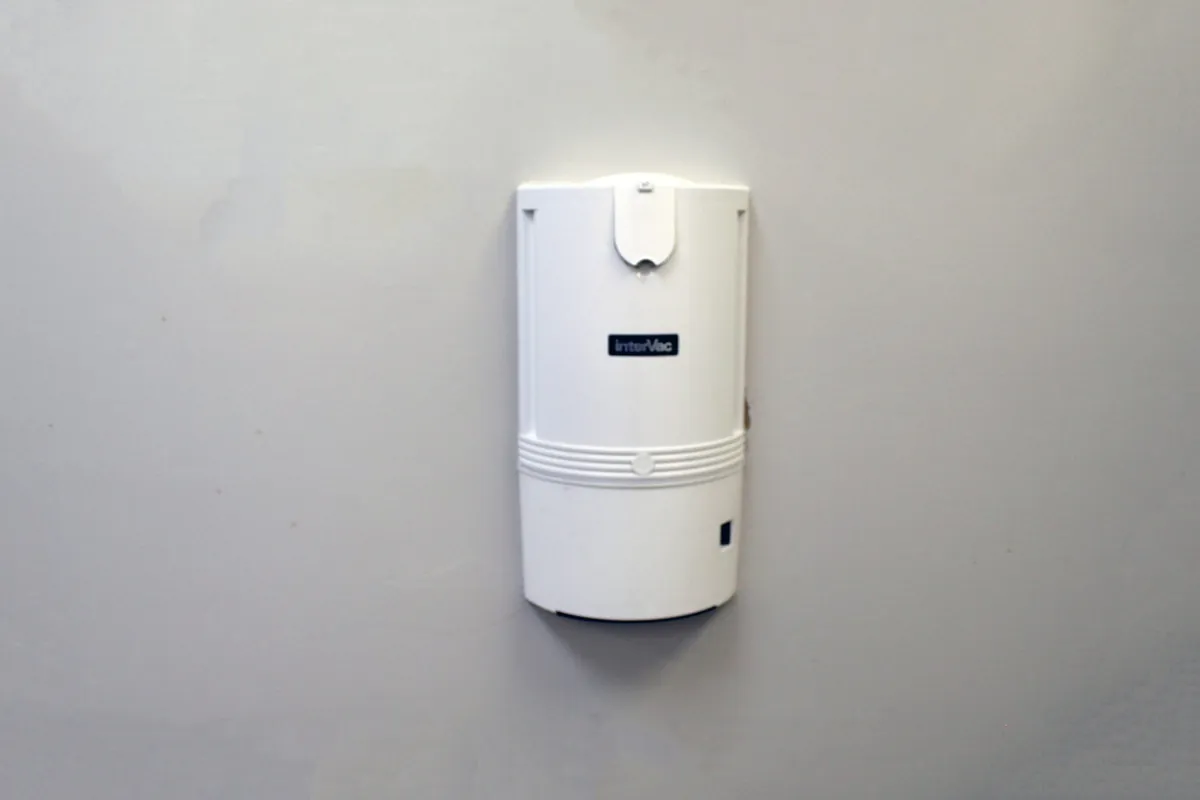
Made by InterVac
Designed, molded and assembled in Palm City, Florida.
InterVac Design Corp designs its vacuums and molds and assembles them at its plant in Palm City, Florida. Some components are sourced globally. The same engineering is factory-installed in tens of thousands of new RVs every year.
Common questions
Is a central vacuum better for allergies?
A central vacuum exhausts outside the living space, so fine dust that gets past the filters doesn't come back into the room. That's the main reason people with dust sensitivities choose one. It isn't a medical device; ask your doctor about your specific situation.
How much does a central vacuum cost?
InterVac power units start at $177.91 for the Mini as a replacement unit, $279 for the UltraVac and $453.22 for the whole-house InterVac Pro. A piped install adds tubing, fittings and inlet valves; a basic fitting set is $34.43.
Can I install it myself?
Many homeowners do. Our installation guide walks through planning the unit location, inlets and tubing. The self-contained UltraVac and Mini just mount on a wall and plug in.